Showing posts with label Asian. Show all posts

Paul's Pork Wontons

>> Sunday, May 13, 2018

This easy recipe for pork wontons is one that my step dad Paul learned when he was teaching agricultural methods in Vietnam during the war. My mom calls them "little porkies".

In this photo, Paul is grilling with his brother in my parents' annual family barbecue, the August Corn Fest. They set up big tables and chairs on the back acre that was once used as an animal paddock, and grill up a couple hundred ears of corn picked from their fields. He's a good griller as well as a cook.

The wontons in the picture below have been steamed. They can be fried, steamed, boiled in soups, or whatever else your imagination suggests. Here is my Dad's recipe.


Ingredients

1 lb. Ground Pork
1/2 cup green onions, diced
2 tsp ground ginger
2 garlic cloves, minced
Won Ton Skins
Hot Chinese Mustard
Teriyaki or Soy Sauce

Directions

I take a pound of ground pork and cut into 4 sections. This gives us about 12 to 14 pieces per section. Mix diced green onions, ginger, and garlic into the pork.

Take one wonton skin and wet one side with water, place a dash of ground pork on the center of the wet won ton (amount of pork is determined by you) and then fold the wonton and seal. Place on plate to deep fry later.

The original process calls for rice paper instead of wonton skins. Rice paper comes dry but need to be moistened with water so it can be rolled with ground pork in it.

Deep fry the wonton skins with the pork. I use a skillet with frying oil. Caution: warm oil slowly and do not over heat or the little porkies will come out dark brown and raw inside (that’s a no-no). When lightly brown and floating on the oil, turn them over to cook on the other side for about the same time.

Mix to taste, teriyaki or soy sauce with Chinese Hot Mustard. Dip deep fried wontons into the sauce and enjoy. We serve the cooked won tons with a vegetable stir fry over rice. 

Note: The original sauce is fish sauce with nothing added.
Serves 4.

Read more...

Hanoi-Style Pork and Chicken Vermicelli Soup (Bún Chả Hà Nội)

>> Saturday, November 25, 2017


Hanoi-Style Pork and Chicken Vermicelli Soup (Bún Chả Hà Nội)

Ah, our jobs keep us too busy to travel in the near future. Instead, Joe and I whipped up a savory bowl of this traditional soup from Hanoi. According to Vietnamese chef Eric Nguyen, this is popular street food in found only in that northern city. People eat it for breakfast, lunch, and dinner.


We simplified his original recipe in the cookbook My Vietnam by using chili-garlic paste instead of a bird's eye chili, and instead of pork terrine, we added tofu that we needed to use up. This was fresh-tasting and satisfying, and the leftovers were just as good.

Ingredients

8 cups hot chicken broth
2 tsp sugar
1/4 cup fish sauce
2 cloves garlic, minced
2 tbsp chili-garlic paste
2 tsp salt
3 oz boneless, skinless chicken breast, cubed
3 oz pork fillet, cut into matchstick slices
4 oz firm tofu, cubed
9 oz dried rice vermicelli noodles
2 eggs
2 tbsp vegetable oil
2 tbsp green onions, cut into matchstick slices
1/2 cup cilantro leaves
1/2 cup mint leaves
1 cup mung bean sprouts
Shrimp paste, to taste

Directions

In a large pot, stir together the chicken broth, sugar, fish sauce, garlic, chili-garlic paste, and salt. Bring to a boil, then drop in the chicken, tofu, and pork. Reduce heat, cover, and simmer for 20 minutes. Remove the meat and tofu to a bowl and keep it warm; keep the broth simmering until ready to serve.


Cook the vermicelli according to package directions, until it is barely tender. Rinse in cold water and allow it to drain, stirring to prevent it from sticking. Add a little oil if the noodles start to clump - rice noodles can be very sticky.

Slightly beat the eggs. Place a large non-stick frying pan on the stove and warm the oil. Pour about 1/4 of the egg into the pan in a thin layer. Cook for one minute, until just set, then flip it over and cook the other side. The egg should be very tender. Slide the egg off onto a cutting board. Repeat with the rest of the egg mixture, stacking the egg "pancakes" on the cutting board. Then roll the egg stack into a cylinder and cut it into thin slices.

a roll of egg "pancakes"


Cutting egg rolls


Ladle the broth into each person's bowl. At the table, let each guest add vermicelli, then the meats, then the egg strips. If desired, stir a little shrimp paste into the bowl. Top with green onions, mint, and bean sprouts, and provide extra fish sauce for dipping. Store leftovers separately so that the tofu and rice vermicelli don't get gummy by soaking in the broth.

Serves 4-6.

Read more...

Curried Pumpkin Hummus

>> Sunday, November 12, 2017


Curried Pumpkin Hummus


As well as pumpkin, you can also use any kind of winter squash in this recipe. Those slightly sweet fall squashes pair naturally with Indian spices like curry powder, ginger, and coconut milk. If you use a squash like butternut or acorn, just quarter it, scoop out the seeds, and microwave the pieces for 15-18 minutes, until it's tender. Let it cool a bit before measuring out 2 cups of squash into the food processor.

bowl of fall squashes


Serve this hot with naan and cucumber-yogurt raita sauce, and you have a healthy Meatless Monday meal. Skip the yogurt, and it's vegan, too!

P.S. The toasted pumpkin seeds in this recipe are shelled; we buy them from the grocery store that way. I've never shelled my own but I don't think I'd want to. Sometimes you can find these in ethnic aisles of grocery stores, labeled as "pepitas".

Ingredients

1 15 oz. can garbanzo beans, drained
1 15 oz can pumpkin
2 tbsp sweet curry powder
1 tsp garlic powder
1/4 cup roasted pumpkin seeds (pepitas)
1 teaspoon fresh grated ginger
1 Thai chili pepper, seeded and minced
1 tsp salt
1/3 cup light coconut milk
1 1/2 tsp sesame oil

Directions

Toast the pumpkin seeds in a dry frying pan until slightly browned and fragrant.

Place all ingredients in a blender or food processor, and process on high until smooth and creamy. If you like a little texture to your hummus, reserve 1/4 cup garbanzos, add them towards the end of the processing time, and blend them until the mixture is just a little chunky.

Put the hummus in a saucepan and heat until steaming hot, stirring frequently, about 5 minutes. Pour into a bowl and top with extra roasted pumpkin seeds, if desired, and serve with naan, pita bread or wedges, or crackers.

Makes about 4 cups of hummus.

Read more...

Szechwan Hot and Sour Soup

>> Tuesday, October 17, 2017


Szechwan Hot and Sour Soup


Joe's test of a good Asian restaurant is the quality of their Sichuan hot and sour soup, so I gave him a kitchen challenge: impress me with your version of hot and sour soup. Oh, and I've been craving Thai shrimp spring rolls, can you do anything to help?

He exceeded my expectations.

I hear that this soup is one of those concoctions that can cure a cold, or just make you feel a whole lot better while you're eating it. Maybe we should start a new category for medicinal recipes.

Ingredients

1/3 lb pork
1 tbsp dried wood ear mushrooms
2 tsp salt
1/2 cup shiitake mushrooms
1/4 cup bamboo shoots
1 small carrot
3 oz. tofu
1 green onion
2 tsp grated ginger
2 tbsp (30ml) Sichuan preserved vegetables, or 2 tbsp chili-garlic paste
5 cups pork broth
2 1/2 tbsp cornstarch
2 tbsp rice wine vinegar
1 tbsp soy sauce
2 eggs


Garnish:
Red pepper flakes
Sesame oil
1/4 cup chopped cilantro
1/4 cup sliced green onions

Instructions

Place the pork, salt, and woodear mushrooms into a pot and cover with water. Bring to a boil, reduce heat, and simmer until cooked, about 30 minutes. Reserve the cooking liquid, adding more if necessary to make the 5 cups of broth you'll need at the end.

Cut the pork, mushrooms, bamboo shoots, tofu, scallion, carrot, and Sichuan preserved vegetables into matchstick slices. Add to the broth and bring to a boil. Reduce to a simmer.

Whisk together the cornstarch, soy sauce, and vinegar, then slowly stir into the broth. Whisk the eggs.
Pour them in a thin stream into the soup while stirring the broth, so that it forms flaky threads as it swirls into the soup.

Serve in single bowls with the garnishes on the side for the diners to add as they choose.

Serves 4-6.

Read more...

Seared Ahi Tuna with Wasabi Pea Crust

>> Friday, September 22, 2017


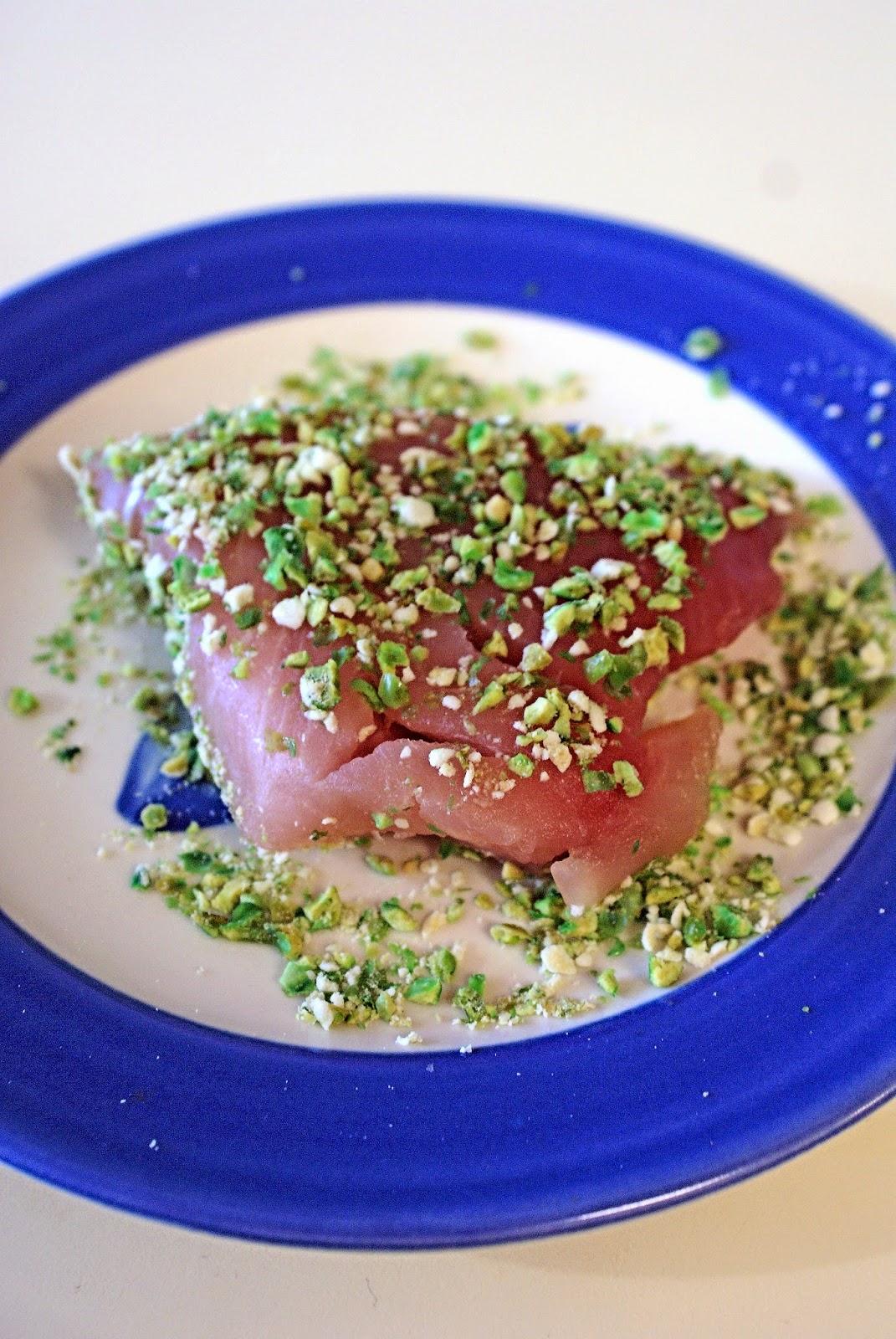
Seared Ahi Tuna with Wasabi Pea Crust


The week before Valentine's Day, I started developing a menu that would surprise Joe, stretch my cooking repertoire, be as healthy as possible, and use up a lot of items in our pantry and freezer as part of our yearly spring cleaning. I made seven courses in the classic French tradition, where the salad is served after the main course. The fish course featured these seared tuna steaks with a crunchy wasabi-pea crust.
Seared Ahi Tuna with Wasabi Pea Crust


We have made this several times since then. Ahi is a low -fat, high-protein meat, and flash-frozen fish fillets tasted just as good in this recipe as high-priced fresh ahi tuna. This is also extremely quick to make, so be sure everything's ready to go before you start cooking.


Ingredients

For the tuna
3 3-4 oz. ahi tuna steaks
2/3 cup wasabi peas - you can often find these in the snack section of an Asian aisle
1 tbsp canola oil

For wasabi-ginger sauce
1 clove garlic, minced
1 tbsp finely grated fresh ginger (about 1 inch)
1/2 tsp red pepper flakes (more or less to taste)
1 1/2 tsp wasabi paste (or wasabi powder mixed with 1/4 tsp water)
1/4 cup rice wine vinegar
3 tbsp soy sauce
2 tsp sesame oil
1 tbsp light molasses (or light brown sugar mixed with 1 tsp water)

Instructions

Let tuna fillets dry on paper towels - the more moisture you absorb, the easier it will be to sear them without moisture seeping out and poaching them instead. This will also ensure they don't soak up much oil.

Put all the sauce ingredients in a blender or food processor and pulse until smooth. Keep at room temperature until ready to serve.

Crush the wasabi peas in a blender, or coffee grinder. You can also put them in a plastic bag and crush them by rolling a rolling pin over them. When you're done, they should be the texture of coarse crumbs. Spread the peas onto a plate.

Heat a wide skillet on medium-high, then add the oil. Press the tuna fillets into the wasabi peas until coated on both sides. When the oil shimmers, place the fish in the pan and make sure they aren't touching each other.

Cook until there's a good sear on one side, then flip over and sear the other side for a minute or so.  You want the sear to be about a millimeter deep, and the center rare at room temperature

That's it! We like to serve them by slicing them across the grain, sort of like a slice of sashimi at a fancy restaurant. This shows the gorgeous contrast between that pretty ruby flesh and the bright green pea crust. 

Serves 4.

Read more...

Sake-Marinated Salmon

>> Friday, August 4, 2017


Sake-Marinated Salmon


Our local grocery store just had a $1.99 a pound sale on salmon fillets, which is about as cheap as I'd ever seen. These fillets were a little thin, but still tender, and they were begging for a delicate marinade instead of the big bold flavors that usually go well with salmon.

I remembered the bottle of sake stored in our bar since - oh, I don't know when - and made a nutty marinade with it. Wasabi or white horseradish gives the fish a little kick, too. The final ingredient is lovage, from a friend's garden. This herb is popular in French and German cooking and boasts a flowery celery flavor. If a friend doesn't have any, snip off the leaves from a stalk of celery and use those instead.

This marinade will work with any fish, but thin fillets are probably best.

Ingredients

4 4-6 oz salmon fillets
1 cup dry sake
1 tsp wasabi paste or horseradish
1 tbsp vegetable oil
1 1/2 tsp lovage, or celery leaves
1/4 cup chives, snipped
Salt and pepper to taste
2 tbsp sesame seeds (optional)

Directions

Wash the salmon fillets and pat them dry. In a bowl, whisk together the remaining ingredients. Place the fish in a platter and pour the marinade over them. Turn them over until the marinade is on all sides. Allow to absorb the flavors for at least 1 hour before grilling or roasting.

Top with toasted sesame seeds before serving, if desired.

Serves 4-6.

Read more...

Coconut Basmati Rice

>> Wednesday, July 20, 2016


Creamy and savory coconut basmati rice


This coconut rice dish is deceptively simple - only 5 ingredients, and 20 minutes to prepare! It's also subtly flavored by the basmati rice and creamy coconut milk. Adjust the amount of jalapeno pepper to your taste, or leave it out completely if you prefer. We like this side dish with grilled fish, but it's pretty versatile side for other meals.

Ingredients

1 1/2 cups basmati rice
1 13.5 oz can low fat coconut milk
1 cup chicken or vegetable stock
1 tbsp Thai birds-eye or jalapeno pepper, minced
3 stalks green onions, chopped

Directions

Rinse and drain the rice until the water runs clear - washing off the surface starch helps prevent the rice from getting sticky or gummy.

Add all ingredients to a medium saucepan and bring to a boil. Reduce heat, and let it simmer for 17-20 minutes, until the rice is just tender and fluffy. 

Makes 4-6 servings.

Read more...

Beef and Asparagus in Black Bean Sauce

>> Friday, April 29, 2016


Beef and Asparagus in Black Bean Sauce


Ahh, this is tasty Chinese take out food that you can make at home faster than the delivery guy can send it. I have to admit, I didn't know what exactly made up "black bean sauce"; I was in the grocery store one day and thought, I have a couple cans of black beans at home, and I bet I could make this sauce pretty easily.

Nope. Black bean sauce is made from fermented soybeans, and I could probably learn how to ferment those beans into that thick and umami-rich sauce, but a jar of black bean sauce is about 3 bucks and I'm working on a fast and easy dinner here.

So whip this up in 20 minutes next time you're craving Chinese, and relax with a full, satisfied belly.

Beef and Asparagus in Black Bean Sauce

Ingredients

3 cups water
1 1/2 cups white rice
2 tsp oil
1 pound beef stew meat
1 pound fresh asparagus (or frozen bits if asparagus is out of season)
2/3 cup yellow onion, sliced
6 oz. sliced water chestnuts, drained
1/2 cup black bean sauce
2 tbsp cornstarch stirred into 1/2 cup cold water

Instructions

Rinse the rice until the water runs clear. Place the 3 cups water and rice into a pot, bring to a boil, cover, reduce heat to medium-low, and simmer 20 minutes.

Cut the asparagus into 2-inch segments and steam for 5 minutes in the microwave. While it is steaming, heat the oil in a wok or high-sided frying pan, and saute the beef until browned. Add the asparagus, onion, and water chestnuts, and cook for 5 minutes. 

Whisk together the black bean sauce and cornstarch mixture, and pour over the beef mixture. Cook and stir until the sauce is thickened, 5-8 minutes. Serve over the rice.

Serves 4-6.

Read more...

Vietnamese Grilled Steak Salad with Cabbage and Peanuts

>> Sunday, April 3, 2016


Vietnamese Grilled Steak Salad with Cabbage and Peanuts


After St. Patrick's Day, we had half a cabbage and absolutely no desire to eat any sort of cabbage dish that reminded us of winter. We were looking for something fresh and bright and not from this climate. This winter has gone on long enough, folks.

Joe dug around in our cookbooks and found this recipe from Melissa Clark's Cook This Now. Seriously, go pick up a flank steak and cook this - now. You'll be happy you did.

Ingredients

For the vinaigrette

2 tbsp soy sauce
1 tbsp rice wine vinegar
2 tbsp oil
1 tsp Thai or Vietnamese fish sauce, such as nam pla or nuoc mam
Juice of 1 lime
1/8 tsp ground cayenne pepper
1 garlic clove, minced

For the salad

2 carrots, peeled and shredded
10 cups shredded napa or regular cabbage (about ½ head)
¼ cup cilantro, chopped
¼ cup soy sauce
Zest and juice of 1 lime
2 tbsp ginger, grated
2 tsp sesame oil
2 garlic cloves, minced
1 1/4-pound flank steak, rinsed and patted dry
Salt and pepper to taste
1/4 cup chopped peanuts (note: if someone at home has a peanut allergy, try toasted slivered almonds or toasted sesame seeds instead)

Instructions

In a screwtop jar, shake the vinaigrette ingredients until well mixed. Keep at room temperature until ready to serve. Toss together the carrots, cabbage, and cilantro; refrigerate until ready to serve.

Whisk together the soy sauce, lime juice, zest, ginger, garlic, and sesame oil.  Place the steak in a dish or pan and coat with this marinade, being sure to cover both sides. Cover the dish with plastic wrap and refrigerate for at least 1 hour and up to 12. Remove the meat 30 minutes before grilling.

Sprinkle the meat with salt and pepper, and grill or broil over medium high heat about 3 minutes per side (for medium rare) or up to 5 minutes (for well done). Toss the cabbage mixture with half the vinaigrette, then arrange on a platter. Slice the meat thinly across the grain into strips and arrange them on top of the cabbage. Drizzle with the rest of the vinaigrette and sprinkle with the peanuts.

Serves 4-6.

Read more...

Thai Drunken Noodles (Pad Kee Mao)

>> Monday, July 20, 2015


Thai Drunken Noodles (Pad Kee Mao)
The leftovers on my desk the following day. Yum - but yet again I apologize for photo quality.

Last Friday, I went to a Thai restaurant for lunch with my friend Peg - the first time I've seen her since school let out and the teachers let down their hair. With acclimating to my new job, prepping work for my July art show, and getting some new social justice initiatives going at our church, I haven't had any girlfriend time in a LONG time. It refreshed my heart like always.

I admit that I love sticking to favorites in Thai restaurants, even more so when the menu is longer than two pages and I can't make up my mind. I was certain there was Tom Kha Gai (chicken and coconut soup) in my future until the waiter set down bowls of clear mushroom soup. My script was rewritten and the "Drunken Noodles" description sounded wonderful.

It was so good that I went home and looked up recipes immediately. I learned that it got its name from the spicy umami that goes well with lots of beer or probably any other drink you like. Some people also say it's good for a hangover, but I didn't test that theory.

Thai birds-eye chiles for Pad Kee Mao
Thai birds-eye chiles. Tiny little pepper torpedoes.


During my research I also discovered the mouth-watering blog High Heel Gourmet, where the author shares stories about life in Thailand and California along with authentic recipes and lots of wit. She also gave me the most wonderful tip about scrambling eggs in a wok so they don't soak up all the sauce. You'll see it below.

While I toned down the heat and changed the recipe toward my own tastes, it's pretty close to several recipes written by Thai cooks. We made it without meat one night, but of course you can add whatever you like!

Remember, anytime you're cooking something in a wok or with a stir-fry method, the whole process goes quickly. Have everything ready to go and lined up next to the pan so you can toss it in when it's time.

Ingredients

For the sauce
1/4 cup soy sauce
2 tbsp fish sauce
2 tbsp oyster sauce
2 tsp brown sugar
1 tsp white pepper

For the stir fry
1/2 lb chicken, shrimp, beef or pork, thinly sliced against the grain (substitute firm tofu if you like)
1 tbsp cornstarch
3 tbsp canola or peanut oil
3 garlic cloves, minced
1 Thai birds eye chili
2 jalapenos, sliced (2 peppers tasted just hot enough for me, but I like spicy)
1 tomato, sliced into thin wedges
1 onion, sliced into thin wedges
2 cups mixed vegetables, like carrots, broccoli, green beans (try the Asian foot-long beans!), bok choy, sliced green onions, or anything else you like
4 cups thick rice noodles
3 eggs
1 cup Thai basil leaves, coarsely chopped

Instructions

Dust the meat with the cornstarch to tenderize it and seal the surface. The cornstarch will also thicken the stir-fry sauce. Set aside. Whisk together all the sauce ingredients and set aside.

Soften the noodles according to the package directions. If the directions are in a language you can't read, soak the noodles in hot water until soft, stirring occasionally so they don't stick together. Drain and use right away.

Crack the eggs in a bowl and whisk them.

Heat a large wok and high heat, and then add the oil. When the oil shimmers toss in the garlic and cook until tender - about 30 seconds. Add the vegetables and cook until they are starting to get tender. Then add the meat. Stir and cook until all edges are seared. 

Stir in the noodles and toss the ingredients together. Pour on the sauce and toss some more until the food is well-coated.

Turn the heat down to slightly. Move some of the noodle-veg mix away from the side, then pour in the eggs. Flip the noodles on top of the eggs and count to fifteen. The noodles are holding the heat over your eggs until they are somewhat cooked.
High Heel Gourmet says: "The counting is the time the eggs need to set a little. If you crack the egg and start to stir-fry right away, the egg will just disappear and leave the fishy smell and fishy taste behind…yuckkkkk! This is how I get the eggs to look like I just scrambled them and added them to the wok."
Toss the egg with the noodles. Finally, throw in the basil leaves and toss until they are slightly wilted. Serve in bowls, with lime wedges if desired.

Serves 4.

Read more...

Vietnamese Beef Noodle Soup with Mint

>> Thursday, May 21, 2015


Vietnamese Beef Noodle Soup with Mint


Sometimes the heart has its reasons that reason can't explain...and sometimes, so does the stomach. I started craving a fresher version of Viet beef soup in the middle of a heat wave last summer. We don't usually eat hot soup in the summertime, and eating hot foods when it's hot seemed a little weird.

Yet, my craving remained. And heck, it's mighty steamy in Vietnam most of the time, right? They still love their traditional soups and hot noodles, and after I've tasted some of them, I know they're onto something good. Turns out, spicy and heated foods can actually help us cool off by generating more perspiration. If not that, at least it gives us some perspective on what really hot means!


Beef Pho with mint
Toss in the things you like in an Asian bowl of soup


We love any version of Vietnamese Pho (pronounced fuh), and if anyone has a new recommendation between Chicago and Milwaukee, we'll jump in the car and head over there. But the five-spice powder, heavy on anise and cinnamon, seemed all wrong for my summertime craving. We took out those spices and added cool-tasting mint, cilantro, and basil leaves for freshness.

If you're serving a group, just put the vegetables on the table, spoon some broth over the noodles and beef, and let people customize their own Pho bowl.

Ingredients

6 ounces dried rice-stick noodles (rice vermicelli)
2 tsp vegetable oil
1 tbsp grated ginger root
1/3 serrano chile, seeded and finely chopped
6 cups cups beef broth
1/4 cup Asian fish sauce
1/2 pound beef, very thinly sliced across the grain

On the Table
3 heads baby bok choy, quartered
1/4 pound snow peas, cut diagonally into 1/4-inch strips (1 cup)
1 cup sliced green onions
6 ounces fresh bean sprouts
1/3 cup sliced mint leaves
1/3 cup sliced basil leaves
1/3 cup chopped cilantro
1 lime, cut into small wedges

Instructions

Cook noodles according to package directions. Rinse in cold water to stop cooking, then drain. Set aside.

In a large pot, heat the oil on high heat and then add the bok choy quarters and sear. When they begin to become tender, place them on a platter and set aside. Saute the ginger and chile for 3 minutes. Stir in the broth and fish sauce. Bring to a boil, then reduce heat and simmer 10 minutes. Add beef and simmer 3 minutes longer.

While broth is simmering, steam the snow peas in the microwave for 2-3 minutes, or until slightly tender. Place all vegetables and herbs on the table.

Place noodles into four bowls and ladle the broth on top. Bring to the tables and let each person add the vegetables they prefer.

Serves 4-5.

Read more...

Thai Coconut Soup (Tom Kha Gai)

>> Friday, March 13, 2015


Thai Coconut Soup (Tom Kha Gai)

I remember exactly when I first ordered this heavenly soup - it was on my first "unofficial" date with Joe.

"Unofficial" date? Joe and I had a complicated courtship. We went to two different churches that did a lot of things together, and people from the two churches had decided to start up a group for single adults in their 30s and 40s. It was a wonderful, hilarious, rowdy, supportive group. Joe and I were interested in each other from the very first meeting.

Problem was, we were both wary from bad relationships, so neither one wanted to make a move. Instead, we did silly things like maneuver into the same car on trips or try to sit next to each other at the theater.

Then Joe went on an evangelistic trip to Argentina and asked me to pray for him. When he came home, we met for pizza so I could hear about his adventures. Then he asked me if I was interested in checking out the new Thai place that had opened by my church. We had a date!

The awkward part was leaving from the singles' group bible study the following week. Everybody was asking if we wanted to go get a bite to eat, and we were lingering by our cars waiting for everyone to leave so we could secretly have our date. It was February and well below freezing, so we were relieved when we got to Lovely Thai and our group hadn't picked the place for dinner. Tom kha gai soup sounded delicious. Creamy, savory, tart, salty, and slightly spicy, it warmed me all the way through.

Recently I read that tom kha gai (say it DOM-kah-guy) is actually a super food for boosting your immunity. The lemongrass, lime leaves or zest, ginger, garlic, hot peppers, and coconut milk are immune system enhancers. Not only does it warm you up and loosen your respiratory system, it helps your digestion too. So when I was sick with strep throat last week, I made up a big bowl for lunch and dosed myself with soup health. I'd like another pot in front of me right now.

This time, I added water chestnuts and rice noodles because I wanted some bulk to my soup - fighting germs is always hungry work for me. There are a few substitutions here, since some of the ingredients may be out of season or hard to find.

Ingredients

4 cups chicken broth
1 2-inch piece lemongrass stalk
1 tbsp galangal or ginger, peeled and slivered
4 kaffir lime leaves, or the zest of 1 lime and 1 bay leaf
2 chopped red birds-eye chilies, or 2 tbsp chili-garlic paste
2 boneless skinless chicken breasts
1 14-oz can straw mushrooms, drained and sliced, or 1 cup shiitake mushrooms, sliced
2 14-oz cans coconut milk
6 oz medium rice noodles (optional)
3 tbsp fish sauce
2 tbsp lime juice
3 green onions, sliced
1/4 cup chopped cilantro leaves

Directions

Pour the chicken broth into a stock pot and add the lemongrass, galangal, lime leaves, and chilies. Cut the chicken into 1" cubes and add to the pot, along with the mushrooms. Simmer for 20 minutes. Reduce heat and stir in the coconut milk, noodles (if using) fish sauce, and lime juice. Simmer for 5-8 minutes, or until the noodles are tender. Do not let the soup come to a heavy boil or the coconut milk might curdle.

Remove the lemongrass, bay leaf, and kaffir leaves before serving. Serve topped with green onions and cilantro leaves.

Serves 4.

Read more...

Spicy Szechuan Green Beans

>> Sunday, March 30, 2014


Spicy Szechuan Green Beans


If you've ever been to a PF Chang's restaurant, you might have tasted these craveable green beans. They have all of the tastiest seasonings the Szechuan province of China can offer. If you can find a jar of preserved Sichuan vegetables, definitely add it to the mix. It adds a powerful punch of flavor.

These are traditionally made with foot-long Asian green beans. If you find them in a store, give them a try - they'll have a different flavor than regular green beans.

Spicy Sichuan Green Beans

Ingredients

1 lb green beans
2 tablespoons fresh ginger, grated
2 tablespoons garlic, thinly sliced
2 tablespoons cooking oil
2 tbsp Sichuan preserved vegetables (optional)

For the sauce 

2 tbsp soy sauce
1 tbsp rice vinegar
1 tsp sugar
2 tbsp Chinese chili-garlic paste
1 tsp sesame oil

Instructions

Rinse and trim the ends off the green beans; steam in a microwave 5 minutes, or until almost tender. Whisk together the sauce ingredients.

Heat the cooking oil in a wok over high heat. Add the green beans and toss in the oil, then drizzle on the sauce and stir-fry until the sauce coats the beans and is thickened. Stir in the preserved vegetables, if using.

Serves 4.

Read more...

Roll-Your-Own Sushi Party

>> Wednesday, February 5, 2014


Roll-Your-Own Sushi Party


I'm hesitant about posting about "how to host a roll-your-own sushi party" because I'd really rather go to each of your homes and make sushi with you. A sushi-making party is the perfect friend experience. Sushi takes a lot of prep but none of it is hard if you have a good sharp knife and a little coordination; the best part is having a glass of wine and catching up with people you love while you julienne vegetables and slice fish into tiny fillets.

I wouldn't say that I could eat sushi every day, but I could eat it a lot, and since you can put an astounding variety of things into them, I could eat a different sushi menu every day. You could start out with a recipe book if you wanted, but it's not necessary. At a recent sushi-making party, we had five cookbooks between the eight of us. But after awhile there were bowls of green onions and spicy tuna and fresh mango slices and an enormous bowl of sushi rice, and everyone improvised the items they put onto hand-formed rice balls and sheets of nori seaweed wrappers.

Starting to make a sushi roll


I'm gonna be realistic and assume you're not all going to invite me to make sushi with you. So here are some tips and ideas for making sushi at home, especially if you have a bunch of friends helping you. We have been making our own sushi for years and have learned a few things about how to help the party flow while actually producing something that wouldn't make a real sushi chef cry.

I originally posted some recipes on my Homemade Sushi post a few years ago (was it really three years ago?). So this post is intended to take the fun a little further with some things we've learned since then. If you have any questions for this avid amateur I'd be glad to answer them.

If you have trouble finding any of these ingredients in mainstream grocery stores, I would like to point you to Asian Food Grocer. I have heard good things about this online store but we live in an area with lots of ethnic variety and have found what we need without their help.

How to Host a Sushi Party

1. Plan for your utensils.

Here are things you'll definitely need on hand. We all had our favorite knives and cutting boards, and several of us brought full sushi dinner place settings which also came in handy when we were rolling.

  • Bamboo mats for making sushi rolls - for 8 people, we used 4 mats; the other 4 people were slicing and forming sashimi
  • Plastic wrap cut to the size of the nori sheets, for making sushi rolls
  • Very sharp knives - we had 6 knives for the 6 people cutting ingredients at the beginning; some knives were just used for raw fish, some for vegetables and fruits
  • Small bowls of vinegar water to seal the sushi rolls and rinse off sticky rice-covered fingers; wet towels are also helpful
  • Chopsticks, plates, and soy dipping bowls
  • Counter/Table space
  • Plenty of cutting boards
Slicing salmon for sashimi

2. Plan who will bring each ingredient to the party.

We made WAY too much food the at our last party. Friends brought home rolls and bits of fish we didn't eat; Joe and I had sushi again the next night, made seared ahi tuna wraps for lunch one day, and used up the rest of our leftovers in a luscious seafood udon soup.

We made sashimi of tamago (Japanese omelet), shrimp, ahi tuna, and smoked salmon. We made sushi rolls of spicy tuna and spicy salmon, California rolls, and rolls that had a mixture of fish, avocado, green onions, mango, and wasabi mayonnaise. Here's a suggestion to feed 8 people:

  • 1/2-1 pound ahi tuna
  • 1/2 pound red snapper filet or smoked salmon 
  • 1/2 pound fresh sushi-grade salmon
  • 1/4 pound crab or crab sticks
  • 1/2 pound shrimp, cooked and cleaned
  • 2 avocados, peeled and thinly sliced
  • 1 small English cucumber, julienned
  • 2 stalks green onions, julienned
  • 1 mango, peeled and pitted
  • 1 small carrot, peeled and julienned
  • 1/3 cup brown or black sesame seeds (toast briefly on a dry hot skillet to intensify the flavor)
  • 1/4 cup fish eggs (the orange fish roe is called tobiko or masago and can be hard to find; try a jar of inexpensive small-egged caviar from the canned meats aisle of the grocery store)
  • 1/2 block cream cheese, cut into thin strips (this works better if you partially freeze it first)
  • Tamago made with 4 eggs
  • Rice vinegar
  • 3 cups uncooked sushi rice
  • 1 piece of Kombu (thick seaweed) for making the sushi rice
  • Chili-garlic paste
  • Soy sauce
  • Pickled ginger
  • Wasabi paste
  • 1/2 cup mayo mixed with 1 tbsp wasabi paste
  • 10 sheets of nori
Tamago sushi and spicy salmon roll sushi

3. Plan the Party.

Once everyone has agreed on what they're bringing, there are a few things the host can do ahead of time. Note that it will take at least an hour, but probably more time to make the sushi, so appetizers and drinks are welcome. Here's a step-by-step plan to get ready for the party.

One Week Before
Finalize the food and utensil assignments; shop.

One Day Before
Make wasabi mayo; if desired, you can make the spicy tuna or salmon a day in advance by mincing 1/2 cup of fish with 3 tbsp chili-garlic paste.

If you'd like to provide a guide to popular sushi rolls, you can print off a list from our sushi post here.

3–4 Hours Before
Chill cold drinks.
Prepare sushi rice and allow it to cool.
Prepare appetizers or starter sushi rolls.

1 Hour Before
Prep ingredients for all sushi rolls.
Set out utensils and prepare a cutting area and a rolling area. We did our cutting in the kitchen, then brought the ingredients to the table and assembled the sushi there.

During the Party
Pour wine, guide slicers and assemblers, and enjoy your friends!

Since many of our friends hadn't made sushi before, we floated between groups showing them how to roll sushi and how thinly to slice different fish. We nibbled as we worked, but then cleared the ingredients off the table and set to eating full platters of sushi in earnest once we had made enough.

That's all there is to it! If you host a roll-your-own sushi party, let me know how it goes.

Read more...

Orange-Glazed Asian Chicken (or Ahi Tuna) Wraps

>> Friday, January 31, 2014


Honey-Orange Glazed Chicken Wraps


We recently hosted a "roll your own" sushi party, and ended up with a vast amount of little bits of leftovers, including avocados, ahi tuna slices, wasabi mayo, and napa cabbage. I marinated some chicken in honey and orange juice, then threw together these yummy chicken wraps for a quick dinner. Joe preferred to marinate the ahi tuna then sear it rare with more sesame seeds for his wrap.

I'm pretty sure avocado is one of the most luscious foods on earth. At my party, I was talking to a friend who trains for triathlons, and she said she eats eggs and avocados nearly every day. Delicious, right?

Then I started thinking about all the calories and fat content in those foods. I thought, well, there's your problem. If you didn't eat eggs and avocados every day, you wouldn't have to do all that running and swimming and biking. I didn't mention it out loud, though, because no one really likes unsolicited advice.

However, you can add as much avocado as you like to this wrap, since the napa cabbage cancels out the fat content. This is one of the quickest wraps I've made - you can prepare the mayo and glaze anytime, start your meat marinating in the morning, then quickly cook it up and get dinner on the table in 15-20 minutes. This is a fantastic lunch sandwich, too.

Ingredients

For the glaze

2/3 cup orange juice
1 tbsp honey
1 tsp sesame oil
1 tsp cornstarch

For the wraps

1 tbsp oil
2 chicken breasts, thinly sliced
1/3 cup mayonnaise
2 tsp wasabi paste or powder
8 large flour tortillas
2 avocados, peeled and thinly sliced
2 cups napa cabbage, shredded
1 large carrot, shredded
1 orange, peeled and thinly sliced
2 green onions, chopped
1 tbsp sesame seeds


Instructions


Whisk together the orange glaze ingredients, then pour over the chicken. Allow it to marinate in the refrigerator at least 30 minutes, but ideally several hours. 

Heat the oil in a skillet over medium heat, and cook the chicken and glaze until the chicken is just cooked through and the sauce is sticky. Place in a bowl.

Whisk together the wasabi and mayonnaise. Heat the tortillas on each side in a dry griddle. Wrap them in a clean kitchen towel or tortilla keeper to keep them warm.

Assemble the wraps by spreading the wasabi mayo on each tortilla. Place the chicken, avocado, oranges, carrots, cabbage, and green onions down the center of the tortilla.  Sprinkle with sesame seeds. Fold in the bottom corner, then roll up the sides.

Makes 8 large wraps.

Read more...

Miso Cucumber Salad

>> Thursday, January 2, 2014


Miso Cucumber Salad

Ingredients

1 large cucumber, peeled and thinly sliced
2/3 cup Carrot, peeled and cut into matchstick slices
1/2 cup Onion, peeled, cut in half, and very thinly sliced
1/2 cup sliced bamboo shoots, drained
1/2 cup Daikon radish, peeled and sliced into paper-thin coins (you can substitute red radishes, if you prefer, but don't peel them!)
1/2 cup Sugar snap peas, bias-cut into 1/2-inch slices
1/3 cup light miso paste
2 tsp sesame oil
1/3 cup rice vinegar
1/2 tsp sugar

Instructions

Whisk together the miso, oil, vinegar, and sugar. Arrange the vegetables decoratively on four plates, then drizzle with the miso dressing. Allow to marinate for 20 minutes at room temperature before serving.

Serves 4.

Read more...

Pork and Tangerine Stir-Fry

>> Monday, December 2, 2013


Pork and Tangerine Stir-Fry


I don't know why pork tastes so good in fruit-based sauces and dishes, but it certainly does. Ripe tangerines or those clementine "cuties", along with aromatic Chinese five-spice powder, make a luscious Christmas-tinged meal.


Ingredients

1 lb pork tenderloin, but into 1-inch cubes
1 tsp canola or grapeseed oil
1/3 cup red bell pepper, cut into thin strips
1 tbsp fresh grated ginger
 3 tangerines or clementines, peeled and pulled into sections
1 tsp cornstarch whisked into 1 tsp warm water
2 tbsp Asian sesame oil, divided
1/4 cup Asian sweet chili sauce (we like Mae Ploy brand)
2 tbsp soy sauce
1/4 teaspoon Chinese five-spice powder
6 baby bok choy, hard bases removed, and cut into 1" diagonal strips
5 green onions, thinly sliced on a diagonal, divided
White or brown rice for serving

Directions

Heat the oil  in a wok or large non-stick skillet over medium-high heat. Toss in the pork and stir-fry until browned on all sides, 3-5 minutes. Remove the meat.

Add the pepper, ginger, and clementines to the wok and stir-fry until slightly tender, about 3-5 minutes. Return the meat to the pan. Stir together the cornstarch, sesame oil, chili sauce, soy, and five-spice powder and pour into the pan. Add the bok choy and half the green onions and toss and cook until the bok choy is slightly wilted. Transfer to a serving dish, sprinkle with the rest of the green onions, and serve with rice on the side.

Serves 4-6.

Read more...

Shoyu Pork Ramen Noodles

>> Wednesday, September 4, 2013


Shoyu Pork Ramen Noodles


In our last free issue of Bon Appetit magazine (September 2013), they're featuring a recipe for pork shoyu ramen. Shoyu is a type of soup base made with soy, and their version sounds wonderful. The only thing is, it takes 3 days to make.

We are crazy about authentic ramen dishes, but not so crazy that we'd plan ahead to start making the broth one day, cooking the meats the next, and assembling the soup on the third day before serving. Granted, it's not a whole lot of work, it's just that we're a bit more spontaneous about dinner than that. So we took their recipe, made a few short-cuts, and loved the results.

If you start this recipe in a crock pot, final touches and assembly at the end will take only about 10 or 15 minutes. This makes a quick and easy restaurant-quality dinner for a weekday meal!

I'd made chicken stock the week before because I had boiled some chicken thighs with vegetable scraps to make Cranberry-Chicken Pasta Salad. Chicken broth from powdered bouillon or canned broth works, also. If you can't find kombu, the thick dried Japanese kelp that flavors the broth, or dried Bonito fish flakes, drop in a fish bouillon cube from Knorr or Better Than Bouillon. The flavor boost is fantastic.

Crazy about ramen too? Try our Spicy Chili-Chicken Ramen.

Ingredients

For the soup

1 1/2 lbs boneless pork shoulder
2 4x2" pieces of kombu
1/4 cup bonito flakes
1 cup soy sauce
1/4 cup sake
2 tbsp rice vinegar
6 cups chicken broth or bouillon
6 cloves of garlic, peeled and chopped
2 bunches green onions, chopped
1 1-inch piece of ginger, peeled and thinly sliced
1 5-oz can bamboo shoots
2 carrots, peeled and cut into 1/2" coins

For the garnishes

3 large eggs
Six 5-oz packages fresh wavy ramen noodles, or 3-oz. packages dried wavy ramen noodles (try to find ones that haven't been fried)
About 3 tbsp chili-garlic paste
About 3 tbsp sesame oil

Directions

Tie up the pork shoulder in kitchen twine so that it doesn't fall apart during cooking. In a large stock pot, brown the pork on all sides in the oil. Place the kombu, bonito flakes, soy, sake, vinegar, chicken broth, garlic, half of the green onions, and ginger into the pot. Bring to a boil, reduce heat, and simmer, covered, until the meat is tender, about 2 1/2 to 3 hours. Note: this part can be done in a crock pot on low heat, simmering hands-free all day.

Remove the pork from the stock pot and allow it to cool. Strain the broth through a sieve and return to the pot; if there are less than two quarts of stock, add more water or broth. Place the bamboo shoots and carrots in the broth and bring to a boil. Reduce heat, and simmer for 10 minutes.

In a separate pan, cook the noodles according to the package directions, then drain and set aside. Bring a medium pot of water to a boil, then gently add the eggs, and boil for 7 minutes. Rinse them in cool water, then peel them and slice them in half. Slice the pork into 1/2" circles.

To assemble the bowls of soup, divide the noodles between six deep bowls, then divide the pork between them. Ladle the soup and vegetables over the noodles, then add an egg half to each bowl. Sprinkle with the other half of the green onions. Bring the chili-garlic paste and sesame oil to the table, and let each diner drizzle over the soup as much as they choose.

Serves 6.

Read more...

Napa Cabbage Crunch Salad

>> Wednesday, April 10, 2013


Napa Cabbage Crunch Salad

This salad is a refreshing way to get some leafy greens into your diet, without making the same old tossed salad or coleslaw. We love the Asian-inspired vinaigrette. Joe's a master at blending a creative oil and vinegar dressing!

This salad keeps well when it is refrigerated, and doesn't get soggy.

Ingredients

For the vinaigrette

Juice of 1 lime (about 3 tbsp)
¼ cup Mirin (sweet soy sauce)
1 tbsp rice wine vinegar
2 tsp sesame oil
1 tbsp vegetable oil
2 tsp fish sauce
2 garlic cloves, minced
2 tablespoons ginger, grated

2 carrots, peeled and shredded
1/2 cup Daikon radish, peeled and shredded
10 cups Napa cabbage, shredded
Salt and pepper to taste
1/4 cup chopped peanuts or almonds
2 tbsp fresh mint, chopped

Directions

Whisk together all vinaigrette ingredients and let sit at room temperature for at least 30 minutes. Combine the salad ingredients and toss with the dressing.

Serves 6-8.

Read more...

Thai Lemongrass Chicken

>> Wednesday, March 6, 2013


Thai Lemongrass Chicken

Thailand is one of Asian countries we'd like to visit the most, in part because of the culture's light and savory recipes. Luckily for all us Thai food lovers, their cuisine has become so popular and well-known that it's much easier to find the ingredients to make authentic dishes.

In our sometimes disorganized lives, Joe and I have bought fresh lemongrass, which is a stiff greenish-beige stalk about eight inches long, and then forgot it was in the vegetable bin. Eventually the grass gets as tough as that bamboo mat in the photo, and we would have to throw it out. If you have the same problem, or you have trouble finding fresh lemongrass at a grocery store, try buying it dried from the spice section of your store. Just soak it in boiling water for about 15 minutes before draining it and using it in a recipe.

Ingredients


For the sauce

1 cup fat-free chicken broth
Juice of 1/2 lime (1 tbsp)
1 tsp lime zest
1/2 tsp sesame oil
1/4 cup soy sauce
2 tsp corn starch mixed in 2 tsp cold water (for thickening)

For the meal


12 oz. spaghetti or rice noodles
1 tbsp oil
1 tsp red pepper flakes
2 large boneless, skinless chicken breasts, cut into 1-inch cubes
2 garlic cloves, minced
3 tbsp lemongrass, minced
1/2 cup green onions or garlic chives, chopped
1 1/2 cups Napa cabbage or baby bok choy, shredded
1/2 cup mung bean sprouts

Thai Lemongrass Chicken in wok

Directions

Cook the spaghetti according to the package directions, and keep warm. Whisk together the sauce ingredients in a bowl.

Heat the oil and pepper flakes in a hot wok until the pepper is sizzling, then add the chicken and stir-fry it at a high heat until the chicken turns from pink to white on all sides - 4 to 5 minutes. Add the vegetables and stir-fry for 2 more minutes.

Toss the noodles with the chicken mixture in the wok. Pour the sauce over the chicken mixture and simmer for 5 minutes, until the chicken is cooked. Sprinkle with 2 tbsp of cilantro before serving, if desired.

Makes about 6 one-cup servings.

Read more...
Related Posts Plugin for WordPress, Blogger...

  © Blogger template Simple n' Sweet by Ourblogtemplates.com 2009

Back to TOP