Showing posts with label Beef. Show all posts

Beer-Braised Beef and Mini Yorkshire Puddings

>> Friday, January 11, 2019


Beer-Braised Beef and Mini Yorkshire Puddings

We found this beer-braised beef recipe in Julia Child's "Mastering the Art of French Cooking". She says beer is typical for a Belgian braise, and the recipe is called "Carbonnades a la Flamande". The beef is cut into small cutlets, quickly browned, then braised with onions and beer until it is falling-apart tender. The beer, brown sugar, and vinegar give it a wonderful sweet-and-sour flavor.

Joe and I didn't know for sure the difference between braising and stewing, but Julia tells us that to braise food, you cook it in oil first, then finish it with some liquid. Stewing is nearly the same, with or without the browning step, but the food is cooked with a large amount of liquid, and the end result is much more soupy.


beef cutlets browning in pan


We decided to tackle Yorkshire pudding, something we've never made before, because we're making it as an accompaniment to my mom's standing rib roast for Christmas dinner. Joe's English side of the family, the Finchams, come from Yorkshire, so it seemed a nice tie-in. And as I've read so much Victorian literature, I've been curious about Yorkshire pudding.

Actually, the British concept of pudding is rather puzzling to Americans in general. Yorkshire pudding is a light batter that bakes up like a popover, but their black pudding is essentially a sausage, and plum pudding is similar to a fruitcake, and often people say pudding to mean any kind of dessert at all.

Yorkshire pudding is easy to make and a traditional accompaniment to a Sunday roast. Joe found that the first mention of it was in a cookbook in the early 1700s. Cooks would place a pan of the batter underneath a roast and let the juices drip down to flavor the pudding. Nowadays cooks spoon a bit of the roast's drippings over the batter as it bakes, and the result is a fluffy, savory muffin whose crown rises then collapses when it cools.

Miniature Yorkshire Puddings
These puddings are not burnt - they are brown from the rich beef juices we poured over them.

While bakers often make Yorkshire pudding in on pan and cut slices for diners, we made these in mini muffin tins so that people at dinner could try just a little bit without taking too much if they happened to not enjoy it. I don't think there will be any left, though!

Ingredients

Yorkshire Pudding

1 cup all-purpose flour
3/4 cup milk
1 tsp salt
2 large eggs
3 tablespoons beef drippings and fat

Beer-Braised Beef

1 3-lb top round roast or tenderloin
2 tbsp oil
6 cups onions, sliced
salt and pepper to taste
4 cloves garlic, minced
1 cup beef stock
3 cups Pilsner-style beer
2 tbsp light brown sugar
6 sprigs parsley
1 bay leaf
1 tbsp fresh marjoram
1/2 tsp thyme
1 1/2 tbsp cornstarch mixed with 2 tbsp white wine vinegar


Directions

Preheat the oven to 325 degrees.

To make the Yorkshire Pudding batter, stir together the flour and salt. in a large mixing bowl, beat the eggs and milk. Gradually add to the flour to the egg mixture, beating it into a thin, smooth batter, but being careful not to over-mix it. Let the batter rest at room temperature for 1 hour.


Yorkshire pudding ingredients

Cut the beef into 2 x 4 inch cutlets, about 1/2 inch thick. Place between layers of paper towels and allow it to dry so that it will saute properly. Heat a large skillet, then add the oil and heat at medium-high until nearly smoking. Add the beef strips a few at a time, and quickly brown them on both sides. Set them aside, then pour the oil and beef drippings into a bowl to be used with the pudding.

Reduce the heat to medium and add 1 more tbsp oil. Add the onions and brown them for about 10 minutes, stirring frequently. Set them aside, then saute the garlic until tender. Pour the stock into the pan and bring it to a boil, scraping up the browned bits of food from the pan. Stir in the brown sugar and beer and remove from the heat.

Tie the herbs together in a double layer of cheesecloth or a coffee filter to make a "bouquet garni". That way, the herbs will impart their flavor to the meal without overpowering it or causing the diners to pick stems and leaves from their food.

a bouquet garni - an herb bouquet for cooking
A bouquet garni - an herb bouquet for cooking

In a casserole dish, arrange half the beef strips and season with salt and pepper. Spread half the onions over the beef, place the herb bouquet in the center, then repeat with the rest of the beef and onions. Pour the beef broth mixture over the casserole.

Cover the casserole and place it in the bottom third of the oven. Cook at a slow simmer for 2 hours, or until fork-tender.

Remove the herb bouquet and drain the cooking liquid into a saucepan. Whisk the cornstarch and vinegar mixture into the liquid and simmer for 3-4 minutes, until thickened. Pour the sauce over the meat and keep warm.

Turn the oven to 450 degrees.

Spray two mini muffin pans or a 9 x 11 casserole dish with oil. Pour the pudding batter into the pan or dish about 2/3 full. Measure the beef drippings - you should have 3 tablespoons. If not, add melted butter to make the right amount. Pour this mixture over the batter.

Bake the pudding, without opening the oven door, until risen and golden brown, 15 to 20 minutes. Remove from the oven and serve immediately with the meat.

Serves 6.

Read more...
Rouladen - German Stuffed Beef Rolls

>> Sunday, April 22, 2018


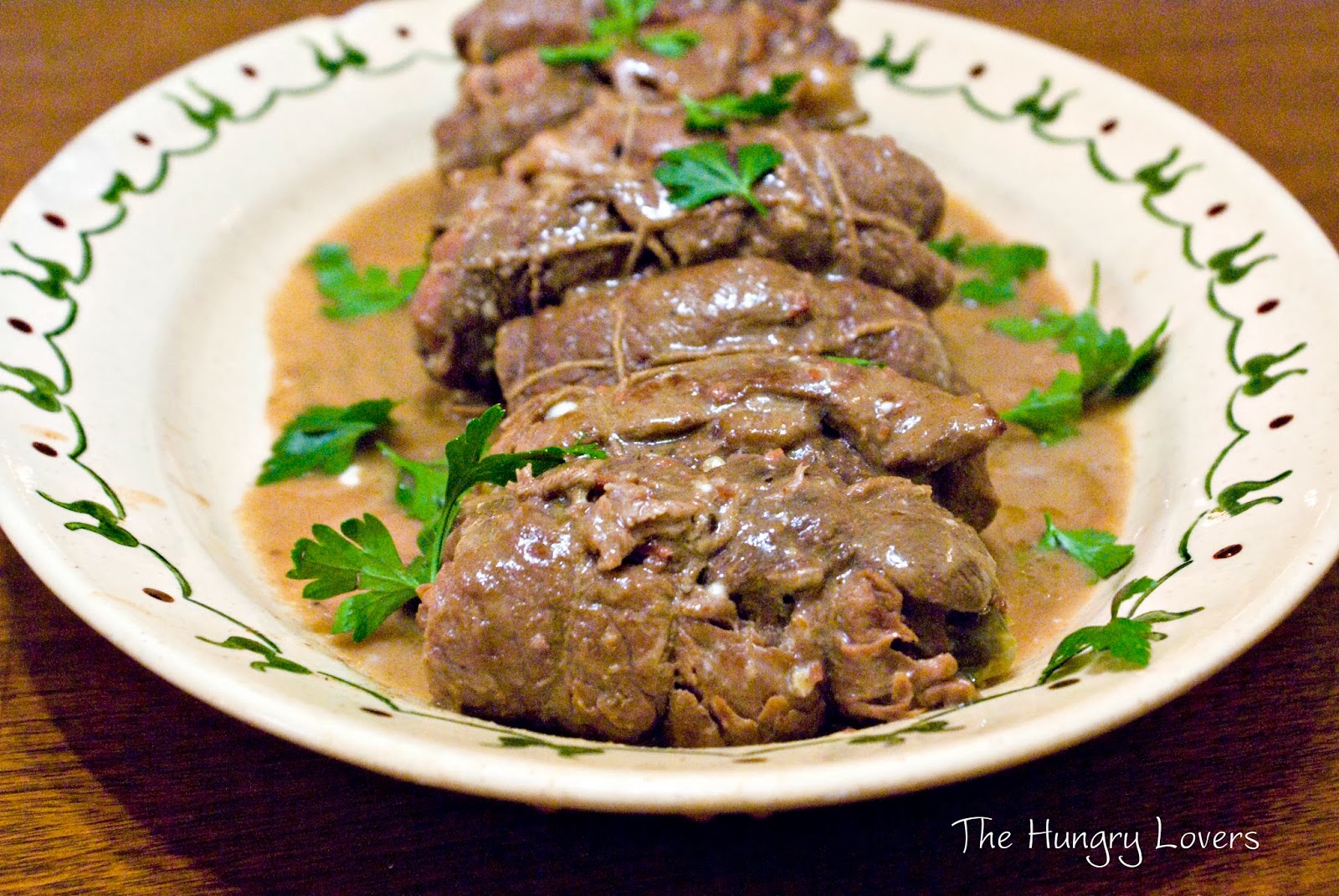
Rouladen - German Stuffed Beef Rolls


This is a classic German recipe that I learned from an American family that lived in Germany for some time. The first version is their rather Americanized (but still delicious) version.

The second recipe is a more authentic German version; we learned it at a German cooking class at the DANK Haus - the German-American Cultural Center in Chicago.

These beef rolls can be served with German spaetzle, egg noodles, dumplings, or mashed potatoes.

Version #1

Makes 6 Servings

Ingredients


1 1/2 pounds round or flank steak
German stone ground mustard, to taste
1/2 pound thick sliced bacon
2 large onions, chopped
1 (16 ounce) jar tiny dill pickles
1 can cream of mushroom soup
1/2 cup sour cream

Rolling German Beef Rolls

Instructions

  1. Cut the flank steak into thin filets; about 1/4 inch thick and 3 inches wide. Generously spread one side of each filet with mustard to taste.
  2. Place bacon and pickle on each filet and form into a roll. Use string or toothpicks to hold the roll together.
  3. Heat a skillet over medium heat. Brown the rolls on all sides.
  4. Place rolls into a crock pot and add the chopped onions. Pour the mushroom soup and 1/2 can of water over the rolls.
  5. Simmer for four hours, or until tender.
  6. After removing the beef rolls, make a gravy by stirring the sour cream into the soup mixture. Serve the rolls with the gravy on the side.
Version #2

Makes 6 servings

Ingredients

1 1/2 pounds flank steak
German stone ground mustard, to taste
1/2 pound thick sliced bacon
2 large onions, sliced
1 (16 ounce) jar dill pickle slices
2 tablespoons butter
2 1/2 cups beef stock
1/2 cup dry red wine
1 tablespoon cornstarch
1/3 cup sour cream

Rouladen ready for cooking

Instructions

  1. Cut the flank steak into thin filets; about 1/4 inch thick and 3 inches wide. Generously spread one side of each filet with mustard to taste.
  2. Place bacon, onions and pickle slices on each filet and form into a roll. Use string or toothpicks to hold the roll together. 
  3. Heat a skillet over medium heat and melt butter. Place the rolls in the butter and saute until browned.
  4. Pour in beef stock and wine and stir.
  5. Simmer the rolls for at least an hour.
  6. After removing the beef rolls, stir in 1 tablespoon of cornstarch and bring to a boil, stirring the liquid until thickened. Serve gravy over the rolls or on the side.

Read more...

Red Wine-Marinated Pot Roast

>> Sunday, February 11, 2018


Red Wine-Marinated Pot Roast

This red wine-marinated pot roast is an old-fashioned recipe with ties to both Germany and France. The juniper berries and cloves are typical of a German beef roast, while the cloves and bay leaves are more typically provincial French. Joe thinks this is the most flavorful, rich way to cook a pot roast, and the herbs and seasoning make it a bit different. This is perfect for a special dinner party or a nice weekend supper.

Start the recipe one a day ahead so that the beef marinates in the red wine sauce for a good long time. Slowly braise the beef the next day with some hearty root vegetables like carrots and onions and you'll enjoy the smells wafting from the kitchen all afternoon. I bet you won't even need to call the family to dinner - they'll be sitting there waiting for it.

When we made this pot roast for Sunday night dinner, we used my great-grandma Therese (Hopfner) Detzner's cream-and-gold china. Seems a shame to just store the china in the cabinet all the time.  I'm sure my very German ancestors would have loved this German-inspired recipe, too.

Ingredients

For the Marinade

2 cups dry, medium bodied red wine (try a pinot noir, syrah/shiraz, or cabernet sauvignon)
1/2 cup carrot, cut into matchstick pieces
1/2 cup onions, very thinly sliced
1/2 cup celery, cut into matchstick pieces
2 garlic cloves, smashed
3 whole cloves, or 1 tsp ground cloves
2 bay leaves
1 tsp whole juniper berries, or 2 tbsp gin (look for juniper berries in a jar at a Whole Foods, Trader Joe's, or  specialty store; keep them in the fridge or freezer for future recipes I will share with you)

For the Roast

3-4 lb nicely marbled boneless chuck, eye of round, or shoulder roast
2/3 cup olive oil
2 large yellow onions
4 large carrots
4 cloves of garlic, minced
6 large potatoes
2 cups beef broth
1/2 cup cornstarch
salt and pepper to taste

Directions

Mix together all marinade ingredients in a non-reactive bowl. Place the meat in the bowl and turn in over several times to coat it with the marinade. Cover and refrigerate until ready to cook (at least 4 hours, but it is best if it marinates for a whole day).

Preheat the oven to 300 degrees.

Drain the meat, retaining the marinade. Pour 2 tbsp of oil into a dutch oven or large pot. Heat the oil, then sear the meat on all sides until well browned (a few minutes per side, including the short sides and ends). Pour the marinade over the meat, cover, and place in the oven. If you prefer to cook this on the stove, bring the marinade to a boil, then reduce heat as low as possible and allow to simmer. Cook the roast for 3 hours, turning and basting occasionally, and adding a little water if the liquid gets very thick or falls below 2" .

Near the end of this cooking time, peel the onions and carrots. Slice the onions into small wedges. Heat 2 tbsp of oil in a frying pan, then brown the onions on all sides. Remove them to a plate or bowl. Slice the carrots into 1" wide pieces on a bias. Heat up 2 more tbsp oil and brown them quickly on all sides. Add them to the onions.

Add the onions, carrots, and 2 of the garlic cloves to top of the meat. Do not mix the vegetables into the pot, or they will get brown and mushy. Cook for 45 minutes more.

In the last 30 minutes of the cooking time, scrub the potatoes and cut them into 2" pieces. Heat the last of the oil and add the potatoes. Brown them on all sides, then add the last two garlic cloves. Add 2 tbsp of water and cover the frying pan. Reduce the heat to low and allow the potatoes to cook slowly.

Remove the roast and set it on a carving block. Discard the cloves, berries, and bay leaves. Strain the vegetables out of the pan juices and put them into a bowl to keep warm in the oven. Pour the cooking liquid back into the pan and add the beef broth. Bring to a boil. Stir together 1/2 cup cold water and the corn starch. Slowly pour it into the broth, stirring constantly. Continue to boil until the broth becomes a thick gravy.

Serve hearty slices of the roast with the sides of vegetables and potatoes, and plenty of gravy. Dinner rolls are great for sopping up the extra sauce.

Serves 6-8.

Read more...

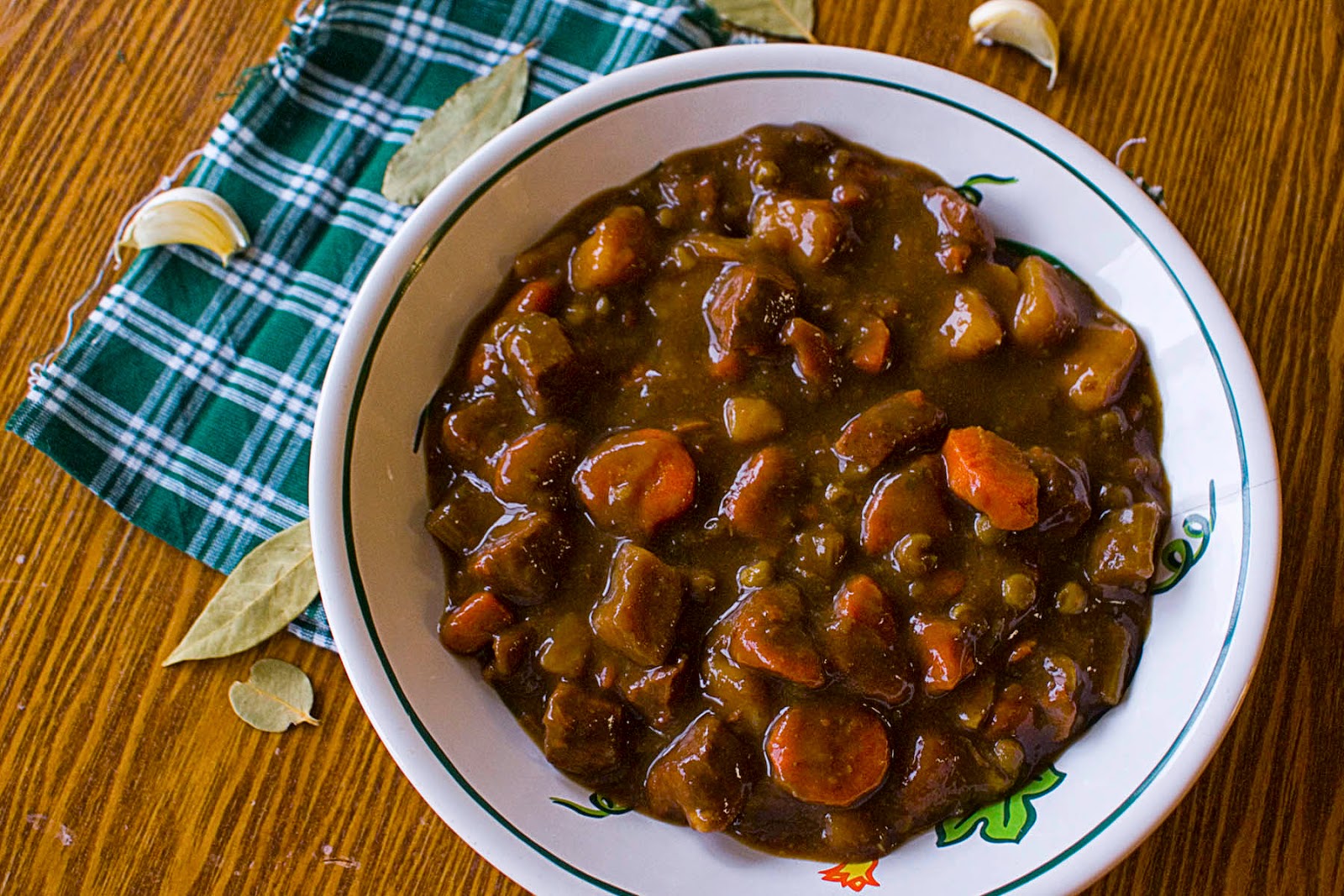
Guinness Irish Beef Stew

>> Monday, January 1, 2018

Guinness Irish Beef Stew


A few years ago I took an Humanities tour of Ireland and Scotland during winter break at my college, studying art, literature, and Celtic culture. We left Chicago on Boxing Day (December 26 to us Yankees) and spent two weeks falling in love with the countryside, the very friendly people, and the rich tradition of art and literature around us.

Irish town
The exuberant colors of Irish buildings. 

I know I fall in love easily when I'm traveling, but there are just so many things to love.

Glendalough Monastery
Glendalough Monastery, founded around 600  A.D.
Dublin Museum of Natural History

During my trip, I tried authentic Irish stew a couple of times. On a chilly day, is there anything better than beef and vegetables slowly simmered in a dark savory gravy? Yes there is! The Irish say, why not add a couple cups of stout beer to the broth?

Angela at Guinness Brewery in Dublin
Guinness DOES taste better at the source: the Dublin brewery's tasting room.
This beef stew is best if it cooks low and slow for a long time, so you can put it in a Dutch oven or a slow cooker and let it melt into delicious stew all day. That's perfect if you want to go to an Irish celebration like the Chicago parades or a local party. By the time you come home, chilled and ravenous, it will be ready for you to devour.


If you visit Ireland, there are at least two things you should know. Between Christmas and New Year's Day, nearly everything shuts down - the entire country is closed. I wanted a friendly Irish family to adopt me for the holiday week as their aunt from America. I would have loved to snuggle into one of those old farm cottages with the peat fires burning on each end of the house, and get in touch with my Irish pride.


The other thing that you should know is that, if you should buy a package of Guinness to sip while you're dressing to go out to the pub with your friends, there is not a single item in the Republic of Ireland that will open the bottles except for a bottle opener. Not a doorjamb, a faucet, your teeth, the sharp corner of a table, a ring, or certainly not your poor tender palms.

Kara opening Guinness bottle
Kara is battling a Guinness bottle with the faucet. The bottle won. You can feel her desperation, can't you?

Instead, just go to the local pub, which is a sort of extension of the Irish living room. You'll get to sing along with the band and maybe even play, if you brought your pipes, bodhrán, or fiddle. You'll definitely enjoy plenty of craic ("crack"), which means good times with good friends, music, and gossip.

Kilkenny pub
Pub in Kilkenny; I'm pretty sure it was called Tynan's Bridge House.

Ingredients

Note: use any combination of veggies you like; this stew is adaptable!
2 pounds beef, cut into 1-inch cubes
1/3 cup flour
2 tbsp oil
2 cloves garlic, minced
2 cups onions, sliced
1 cup parsnips, peeled and cut into 1/4" coins (about 2 medium-sized parsnips)
1 cup carrots, peeled and cut into 1/4" coins (about 2 medium-sized carrots)
1 cup celery, sliced (about 2 celery ribs)
1 cup green peas, fresh or frozen
2 pounds red potatoes, quartered
1 1/2 bottles Guinness or other stout-style beer
4 cups beef broth
1 cup water
2 tablespoons red wine vinegar
2 tablespoons Worcestershire sauce
1 tsp thyme
2 bay leaves

Guinness Irish Beef Stew

Instructions

Toss the beef with the flour until the pieces are well coated on all sides. Heat the oil in a frying pan and brown the meat on all sides.

Stir together the broth, beer, water, vinegar, Worcestershire sauce, thyme, and bay leaves.

If using a crock pot, place half the beef in the pot then half the vegetables, then layer the other half of meat and vegetables on top. Pour the broth mixture over the top and cook, covered, for 8-10 hours on low heat or 4-6 hours on high heat (depending on your crock pot's temperature). When finished, the meat and vegetables should be falling-apart tender.

If using a pot on the stove, place the beef, onions, garlic, and other vegetables in the pot. Pour the broth mixture over the top and stir it together. Bring to a boil, reduce heat, and simmer covered for 60-90 minutes, stirring occasionally. Again, you know the stew is ready when the meat and vegetables are falling-apart tender.

Before serving, remove the bay leaves. Blend together the cornstarch and water and stir it into the sauce. Let it thicken the sauce for 15-20 minutes before serving.

Serves 6-8.

Read more...

Pot Roast Paprikash and Hungarian Pilaf

>> Sunday, October 29, 2017


Pot Roast Paprikash and Hungarian Pilaf


Joe whipped up some Hungarian-style rice pilaf to go along with this. Though we cooked this in the oven, it would work well in a slow cooker, too. When you get home from work, the house will smell amazing, and the rice takes less than 30 minutes to make. It's a Sunday dinner kind of dish for a weekday timetable!


Ingredients

2 pounds beef rump roast
2 tablespoons sweet paprika
14 1/2-ounce can diced tomatoes
14 1/2-ounce can beef broth
2 cups yellow onions, halved and cut into 1/2-inch slices
3 large carrots, peeled and cut into 1/2-inch coins
1 cup red bell pepper, cored and cut into 1/2-inch strips
1/4 cup water
2 tablespoons cornstarch
8 ounce carton low-fat sour cream
Salt and pepper to taste

For the Rice

1 cup long grain rice
2 cups vegetable stock
1/2 cup onions, chopped
2 cloves of garlic, minced 
1 tsp vegetable oil
1 tbsp flat-leaf parsley, chopped
Salt and pepper to taste
1/2 tsp sweet paprika


Directions

Trim the fat off the meat and cut it into quarters.

If using a slow cooker, place the meat in the cooker and sprinkle with the paprika. Top with tomatoes, broth, onions, carrots, and sweet peppers. Cook for 10 hours on low heat or 4-6 hours on high heat.

If using the oven, preheat it to 350 degrees. Brown the meat on all sides, then sprinkle with the paprika. Add the  tomatoes, broth, onions, carrots, and sweet peppers. Bring to a boil, then cover, and place in the middle rack of the oven. Cook at 350 degrees for 2 hours, stirring occasionally.

To make the rice, heat the oil in a saucepan, then add the rice and stir until it turns white and slightly toasted. Add onions and garlic and saute until tender. Add the stock, parsley, salt, pepper, and paprika. Bring to a boil, then reduce heat and simmer, covered, 20 minutes or until the rice is tender and the liquid is evaporated.

When the meat is tender and flaky, put it on a cutting board and shred it with two forks. Skim any fat from the sauce, put the meat and sauce into a saucepan. Whisk together the water and cornstarch, then bring it to a boil and cook 15 minutes, until thickened. Stir in the sour cream and heat on low for 5 minutes. Add salt and pepper to taste, then serve over the rice.

Serves 4-6.

Read more...

Blanquette de Veau (French veal stew with white sauce)

>> Sunday, May 28, 2017


We first had this classic French veal stew at Froggy’s Café – you know, that French place we rhapsodize about. We consulted with Julia Child on the recipe and experimented a little on our own to come up with the recipe here.

While this is technically a basic stew, it's upscale enough for a fancy dinner party. The lovely creamy sauce and tender, buttery veal are a treat for special friends. 

We’ve noticed that some classic French recipes can be rather one-note. For example, the original recipe called for cooking the veal with a carrot, celery stalk and onion, but then discarding everything. The result is the stew contains just meat, mushrooms, and the very flavorful gravy. We switched it up a bit so that we keep all the vegetables in the stew. You might want to play around with this too – but perhaps experiment on something cheaper than veal!


Ingredients

For the Bouquet Garni (Herb bundle)
3” cheesecloth square
Kitchen Twine
1 tbsp parsley leaves
2 cloves
1 bay leaf
1 tsp fresh thyme
6 black peppercorns

For the Stew
2 lbs. boneless veal shoulder, cut into 1″ chunks
2 stalks of celery cut into 1″ pieces
1 cup chicken or vegetable stock
1 cup pearl onions
1.5 cups baby carrots cut in half
10 oz. of mixed mushrooms, such as shiitake, white, crimini, and oyster, sliced
¼ cup sherry
3 tbsp. unsalted butter
2 12 tbsp. flour
½ cup heavy cream
Salt and white pepper to taste
Cooked white rice, for serving
Parsley leaves, to garnish

Instructions

Wrap the herbs in the cheese cloth and tie with the twine. In a large pot, place the veal, onions, carrot, celery, broth and enough water to partially cover the food. Bring to a boil, cover and reduce heat, and simmer one hour. Skim off the scum as it forms. Be careful not to overcook the veal as it will turn to mush!

Add the mushrooms and sherry and cook until the vegetables are tender. Remove the meat and vegetables to a platter and keep warm; return the broth to the pot.

 In a small saucepan, melt the butter. Whisk in the flour and stir in one cup of the veal broth, stirring until smooth. Slowly stir the white sauce into the large pot, add salt and pepper to taste, and simmer gently until it is thickened. Stir in the cream. Return the meat and vegetables to the pot and heat through. Sprinkle with parsley after plating.

Serve over white rice, noodles, or alone with crusty bread.

Serves 4.

Read more...

Osso Buco

>> Sunday, February 12, 2017


Osso Buco


Our love story begins with the post "He Cooks for Me", on Angela's life blog, angelawd.wordpress.com.

“I’d like to cook for you,” He said, a few months after we started dating. “Why don’t you come over for Easter dinner?”

I was excited. News of his prowess in the kitchen had spread throughout our circle of friends at both churches. My girls, according to the alternating visitation schedule, would be with their dad, and my family was too far away to visit. I was glad I wouldn’t spend another holiday alone.

When I got to his condo, I could smell dinner all the way down the hallway – a rich, garlicky aroma. “It smells delicious,” I said. “What are we having?”

“Osso Buco”, He said, wiping his hands on his personalized apron.

He owns his own apron! I shouted to myself. “Osso Buco, that’s great!”

“Have you heard of it before?”

“Uh, no, actually not.”

“It’s braised veal shanks. A classic Italian recipe.”

I was utterly impressed. Guys took me out to steakhouses or seafood places; when they cooked a fancy dinner for me, it was inevitably a steak, a baked potato, and some wine. No one had ever cooked me a meal I’d never even heard of before.

I watched him sprinkle chopped fresh parsley in a delicate pattern over our dishes, and then serve steaming veal with a thick red sauce onto each plate. There were candlesticks and placemats, and a wine that he had to explain before I even had a taste. Something Italian and as dark red and rich as the meal; he had chosen it to complement the veal. I appreciated the explanation. I was used to $3 bottles of White Zinfandel.

When I could eat no more, I sat back and rubbed my stomach.

“What do you think?” He asked.

“I think I love it,” I said, meaning the meal, the wine, the idea of a man who cooks especially for me. Two years later I married him, and in September we celebrated our 12th wedding anniversary.


Wiping away Joe's tear after he said his wedding vows.


Joe actually calls this version of his recipe "Fauxo Buco", because it uses beef shanks rather than the astronomically expensive veal shanks. I call it delicious.


Ingredients

2 tbsp olive oil
2 tbsp butter
2 cups onion, chopped
2 cups carrots, chopped
1/2 cup celery, chopped
2 cloves garlic, minced
6 to 7 pounds beef or veal shank sawed into 2 1/2 inch sections
Salt and pepper to taste
2 tbsp flour
1/2 cup olive oil
1 cup beef stock
1 cup dry white wine
3 cups tomatoes, chopped
2 tsp fresh basil
1 tsp fresh thyme
3 tbsp fresh Italian parsley, chopped
2 bay leaves

For the Gremolata (herb topping)

1 tbsp grated lemon peel
3 tbsp fresh Italian parsley, minced
2 garlic cloves, finely minced

Directions

In a large casserole or Dutch oven, melt half the butter and oil over medium heat. Saute the onions, carrots, celery and garlic until tender. Remove to a separate plate.

Stir together the salt, pepper, and flour, and roll the meat in the mixture. Melt the rest of the butter and oil in the Dutch oven, then brown the meat on all sides, about 10 minutes total. Add the vegetables to the meat.

Preheat the oven to 350°. Pour the wine and broth into the casserole pan, and bring to a boil, scraping up any browned bits sticking to the bottom of the pan. Add the basil, thyme, tomatoes, parsley sprigs and bay leaves; the liquid and vegetable should halfway cover the meat. If it doesn't, add more broth or water. Bring the pan to a boil, then cover and place in the center of the oven.

Braise the meat for about 1 1/2 hours, basting it with the juices occasionally, until the meat is very tender and the sauce is thickened and stew-like. Serve the meat arranged on a serving platter with the vegetables and sauce. 

Alternatively, you can pour some creamy polenta onto individual plates, then arrange a shank and the vegetables over the top. Sprinkle the servings with the gremolata—the piquant garnish of lemon zest, parsley, and garlic.

Serves 6-8.

Read more...

Beef and Asparagus in Black Bean Sauce

>> Friday, April 29, 2016


Beef and Asparagus in Black Bean Sauce


Ahh, this is tasty Chinese take out food that you can make at home faster than the delivery guy can send it. I have to admit, I didn't know what exactly made up "black bean sauce"; I was in the grocery store one day and thought, I have a couple cans of black beans at home, and I bet I could make this sauce pretty easily.

Nope. Black bean sauce is made from fermented soybeans, and I could probably learn how to ferment those beans into that thick and umami-rich sauce, but a jar of black bean sauce is about 3 bucks and I'm working on a fast and easy dinner here.

So whip this up in 20 minutes next time you're craving Chinese, and relax with a full, satisfied belly.

Beef and Asparagus in Black Bean Sauce

Ingredients

3 cups water
1 1/2 cups white rice
2 tsp oil
1 pound beef stew meat
1 pound fresh asparagus (or frozen bits if asparagus is out of season)
2/3 cup yellow onion, sliced
6 oz. sliced water chestnuts, drained
1/2 cup black bean sauce
2 tbsp cornstarch stirred into 1/2 cup cold water

Instructions

Rinse the rice until the water runs clear. Place the 3 cups water and rice into a pot, bring to a boil, cover, reduce heat to medium-low, and simmer 20 minutes.

Cut the asparagus into 2-inch segments and steam for 5 minutes in the microwave. While it is steaming, heat the oil in a wok or high-sided frying pan, and saute the beef until browned. Add the asparagus, onion, and water chestnuts, and cook for 5 minutes. 

Whisk together the black bean sauce and cornstarch mixture, and pour over the beef mixture. Cook and stir until the sauce is thickened, 5-8 minutes. Serve over the rice.

Serves 4-6.

Read more...

Vietnamese Grilled Steak Salad with Cabbage and Peanuts

>> Sunday, April 3, 2016


Vietnamese Grilled Steak Salad with Cabbage and Peanuts


After St. Patrick's Day, we had half a cabbage and absolutely no desire to eat any sort of cabbage dish that reminded us of winter. We were looking for something fresh and bright and not from this climate. This winter has gone on long enough, folks.

Joe dug around in our cookbooks and found this recipe from Melissa Clark's Cook This Now. Seriously, go pick up a flank steak and cook this - now. You'll be happy you did.

Ingredients

For the vinaigrette

2 tbsp soy sauce
1 tbsp rice wine vinegar
2 tbsp oil
1 tsp Thai or Vietnamese fish sauce, such as nam pla or nuoc mam
Juice of 1 lime
1/8 tsp ground cayenne pepper
1 garlic clove, minced

For the salad

2 carrots, peeled and shredded
10 cups shredded napa or regular cabbage (about ½ head)
¼ cup cilantro, chopped
¼ cup soy sauce
Zest and juice of 1 lime
2 tbsp ginger, grated
2 tsp sesame oil
2 garlic cloves, minced
1 1/4-pound flank steak, rinsed and patted dry
Salt and pepper to taste
1/4 cup chopped peanuts (note: if someone at home has a peanut allergy, try toasted slivered almonds or toasted sesame seeds instead)

Instructions

In a screwtop jar, shake the vinaigrette ingredients until well mixed. Keep at room temperature until ready to serve. Toss together the carrots, cabbage, and cilantro; refrigerate until ready to serve.

Whisk together the soy sauce, lime juice, zest, ginger, garlic, and sesame oil.  Place the steak in a dish or pan and coat with this marinade, being sure to cover both sides. Cover the dish with plastic wrap and refrigerate for at least 1 hour and up to 12. Remove the meat 30 minutes before grilling.

Sprinkle the meat with salt and pepper, and grill or broil over medium high heat about 3 minutes per side (for medium rare) or up to 5 minutes (for well done). Toss the cabbage mixture with half the vinaigrette, then arrange on a platter. Slice the meat thinly across the grain into strips and arrange them on top of the cabbage. Drizzle with the rest of the vinaigrette and sprinkle with the peanuts.

Serves 4-6.

Read more...

Greek Meatballs in Avgolemono sauce (Lemon-Egg Sauce)

>> Thursday, March 10, 2016


Gray, chilly March has sunk into our bones. We’re fighting steady against seasonal darkness blues and late winter cold germs, but a dose of sunshine and a glimpse of Greek islands are welcome.

Would like to join us on the island of Santorini?
This recipe is a mash-up of two of our current favorites. Yes, we’re continuing our love affair with the lowly meatball, and we’ll never get tired of the tangy avgolemono soup. This traditional Greek egg and lemon soup turns into a creamy and fortifying stew with our turkey-beef blend meatballs (keftedes). Keftedes are often made of ground lamb, but I just can’t handle the taste of lamb , so it's beef for me!


If we were dining in Santorini, we might order avgolemono because it’s a tradition during Lent, when some people avoid eating meat. We might also lay out in the sun all day until our creaky joints loosen up. I think it’s time for a trip someplace warm!


Ingredients

½ lb. ground beef
½ lb ground turkey
1/3 cup long grain rice, uncooked
½ cup red onion, finely chopped
1 clove garlic, minced
2 tsp mint, finely chopped
2 tbsp parsley, finely chopped
1/3 cup finely crumbled feta cheese
1 large egg
1/2 cup fine bread crumbs3 cups chicken stock or broth

For the sauce:
2 large eggs at room temperature
1/3 cup lemon juice (about 2-3 lemons)


Instructions


Stir together all meatball ingredients except  the broth. Roll into meatballs the size of a ping-pong ball. Place in a dutch oven and cover with the broth. Bring to a boil, reduce heat, and cover. Cook for 30 minutes. Pour the broth into a measuring cup and allow to cool slightly. You can keep the lid on the meatballs and keep them warm in the oven while making the sauce.


Whisk the eggs in a medium bowl until light and frothy. Slowly whisk in the lemon juice, then whisk in the broth a little at a time. Pour the lemon sauce over the meatballs and return the pot to very low heat. Allow the mixture to thicken slowly on low heat – be careful not to let the pot boil or the eggs will curdle.
When the sauce is at a thickness you like, remove from heat and serve.
Serves 4.

Read more...
Related Posts Plugin for WordPress, Blogger...

  © Blogger template Simple n' Sweet by Ourblogtemplates.com 2009

Back to TOP